Vanished Landscape 1
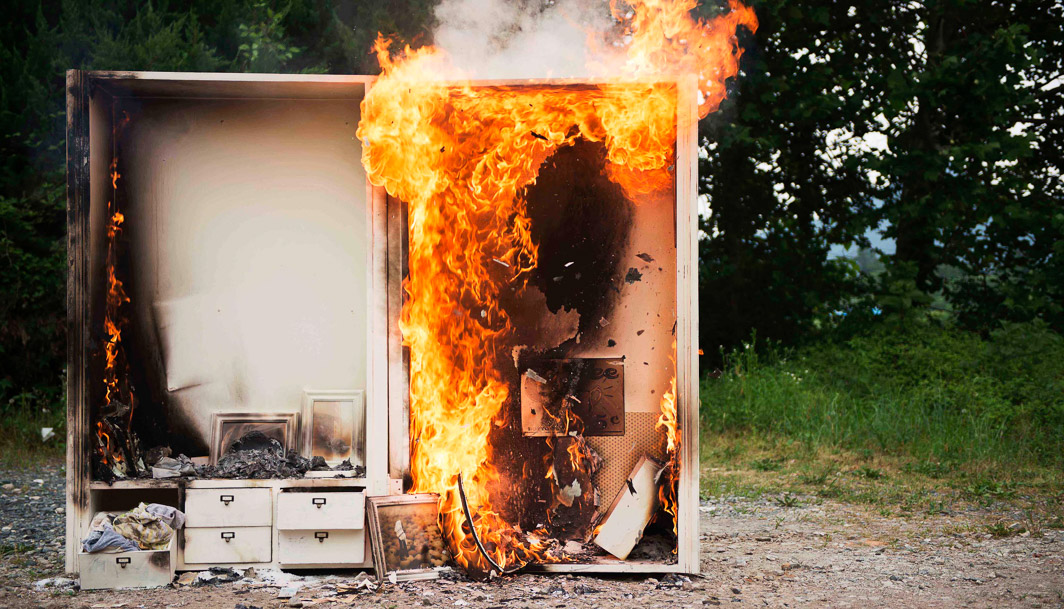
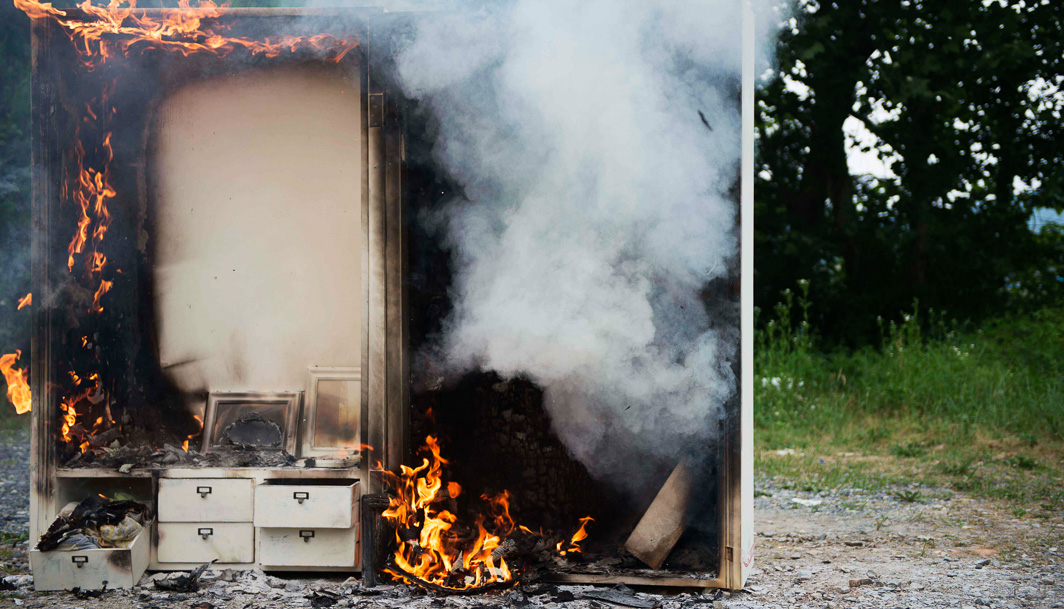
This work documents the burning of a wardrobe installation, drawing on Korean cultural practices where burning the possessions of the dead—or items that cannot be moved to a new home—serves as an act of release and transition. In this tradition, sacrifice is seen as a way to let go of the old, creating space for renewal and future reward.
Frequent moves and migration, combined with limited storage, prompted the transformation of the original wardrobe installation. Unable to keep the piece, I chose to burn it, capturing the process through photography. The resulting diptych, Vanished Landscape 1, emerged as both a record and a byproduct of this act.
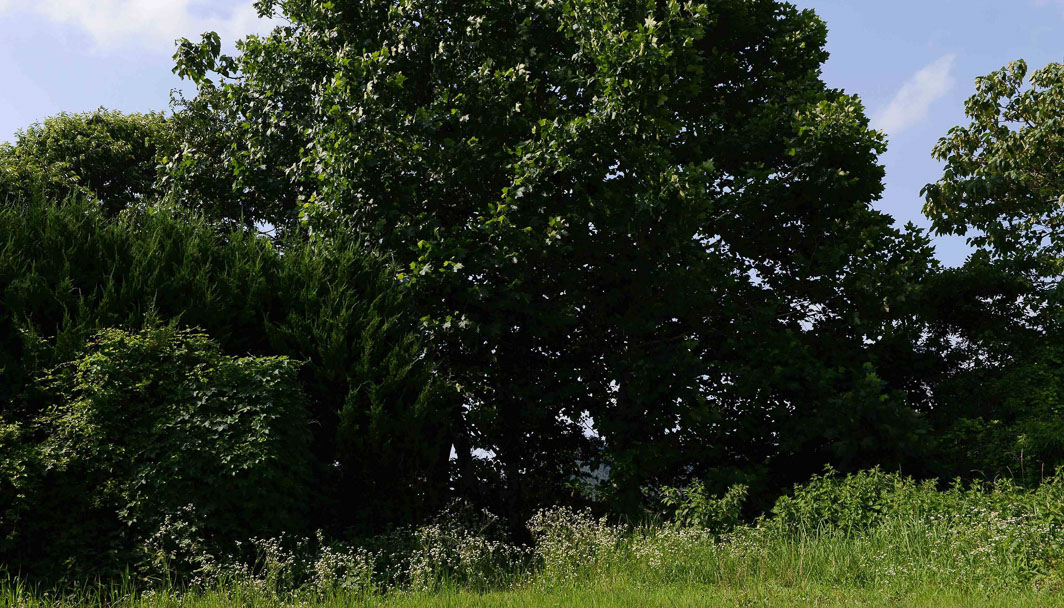
The narrative continued when I returned to the burn site and found the wardrobe’s remains had vanished without a trace. This unexpected absence evoked a sense of loss, prompting me to photograph the empty space as a way to preserve the memory of that moment. This image became the catalyst for Vanished Landscape 2, deepening my exploration of loss, memory, and the transient nature of both objects and spaces
Vanished Landscape 2
Is a video installation that deepened my investigation into theme of loss, memory, and transformation within transient and impermanent spaces. Building upon the photographic work of Vanished Landscape 1, I became acutely aware that not only the objects, but the landscapes themselves were subject to continual change and disappearance over time.
To embody this sense of vanishing, I enlarged the photograph taken after y return to the original burning site. By hanging the print in its original context and filming its burning, I created a visual dialogue between past and present. As the image—representing a fixed memory—was gradually consumed by fire, the current landscape emerged behind it, revealing subtle shifts and new realities. This layered composition highlights the interplay between memory and the ever-changing present.
The burning of the photograph transformed the act of destruction into one of renewal, symbolising the impermanence and cyclical nature of moments and places. The resulting video piece, Vanished Landscape 2, marks a natural progression from still photography to moving image, introducing a temporal and performative dimension that underscores the ongoing transformation of space and memory. Through this work, I invite viewers to reflect on the fleeting nature of experience and the ways in which we continually reconstruct our understanding of place and time.
사진이 보여주는 시간성과 영상이 보여주는 시간성 그리고 매체가 벗겨진 후의 현재의 시간성은 결코 같은 수 없다. 이 다른 시간들의 층위를 한 장면에서 공존시키거나 막(layers)을 벗겨내듯 교차시킨 장면을 보여줄 때 보는 이는 그 시차의 트래지션을 경험하게 될 것이다. 예컨대 영상이 현재성과 운동 이미지를 보여주는 매체라면 그 현재의 시간 속에 과거의 시간을 담은 사진을 교차시킬 경우 두 시간성이 겹쳐지면서 그 시차를 드러내게 된다. 무엇보다도 이러한 원리는 매개와 매개의 재매개 과정을 물리적으로 교차시키는 과정이 될 수 있다. 비장소는 그렇게 매개를 통해 새로운 공간으로 인지된다. 결국 비장소는 매체의 전환 혹은 매체 간의 교차 그리고 매체들이 공존할 때 형성되는 ‘상징적 공간’이다.
결국 장소에 대한 본인의 심화된 실험은 동일한 장소가 다양한 매개를 통해 기록된 장면과 장면이 연결될 때 지각되는 비장소에 관한 연구이다. 본인은 매체의 전환, 교차, 공존을 통해 형성된 비장소에 대한 경험을 공간성의 측면에서 접근할 뿐만 아니라 그 장소가 갖는 독특한 시간성에도 집중한다. 독특한 시간성은 확장된 개념의 현재성으로, 과거와 미래가 함께 겹쳐진 상태의 독특한 현재성을 탐색한다.
…(작품제작 과저와 의미 설명)중략…
본인의 실험은 매개가 전환되는 과정에서 발생하는 상실의 풍경을 연출하고자 다양한 매개를 엮어 놓은 것이다. 이 실험은 오브제에서 사진, 이후 사진에서 영상으로 전환되는 과정에서 새롭게 생겨나는 감각을 통해 특수한 시공간을 조명할 수 있었던 실험이었다. 나아가 매개와 매개의 전환이 이뤄지는 과정을 감추지 않고 그 이음새를 드러냄으로써 두 매체의 경계를 자유롭게 이동하며 경험할 수 있게 했는데, 이는 하이퍼매개적 접근 방법을 보여주는 것이다. 본인는 이 실험을 통해 장소를 실천적으로 경험하게 되었다.
The temporality shown by a photograph, the temporality shown by video, and the present moment revealed once the medium is stripped away are never the same. When these different layers of time coexist within a single scene, or when they are revealed and intersected like peeling back layers, the viewer experiences the transition between these temporalities. For example, if video is a medium that presents the present and movement, then overlaying a photograph—which contains the past—onto the present moment of the video causes the two temporalities to overlap, exposing their time gap. Above all, this principle can be seen as a physical process of mediation and remediation. In this way, non-place is perceived as a new space through mediation. Ultimately, non-place becomes a “symbolic space” formed by the transition, intersection, and coexistence of different media.
My in-depth exploration of place is, in essence, a study of non-place as it is perceived when scenes of the same location—recorded through various forms of mediation—are connected. I approach the experience of non-place not only from the perspective of spatiality, but also by focusing on its unique temporality. This unique temporality is an expanded sense of the present, where past and future are layered together in a distinctive present moment.
…(Omitted: description of the production process and meaning of the work)…
My experiment weaves together different media to create landscapes of loss that arise during the process of mediation and transition. This experiment, moving from object to photograph and then from photograph to video, illuminated a unique sense of time and space through the sensations that emerged with each transition. By intentionally exposing the seams where media and mediation shift, I enabled a free movement between the boundaries of the two media—an approach that demonstrates hypermediacy. Through this experiment, I was able to experience place in a practical, embodied way.
Vanished Landscape 3
Represents the next evolution in my ongoing investigation of impermanence, memory, and the layered nature of perception. Following the physical and photographic sacrifices of Vanished Landscapes 1 & 2, this work shifts focus to the immaterial: the burning of a video projection.
In this piece, I filmed the act of burning a projected video—an image composed entirely of light. Through this process, I realised that what was actually burning was not the image itself, but the screen serving as its surface. The projected image, intangible and fleeting, could only exist through this intermediary layer. This discovery became central to the work: the realisation that every image or idea we perceive is mediated by a surface or layer that reflects light and makes the invisible visible.
Vanished Landscape 3 thus explores the notion of mediation and the necessity of layers to capture, reveal, or even sacrifice the intangible. By sacrificing the medium itself, I invite viewers to consider how all images and ideas are filtered through material boundaries—whether physical, digital, or conceptual—and how these layers shape our experience of time, space, and memory